
What is MPLS?
MPLS, short for Multiprotocol Label Switching, is how carriers move traffic across their own networks. For a business it usually means a private circuit that links offices together without that traffic crossing the public internet.
Talk to an engineer Knowledge base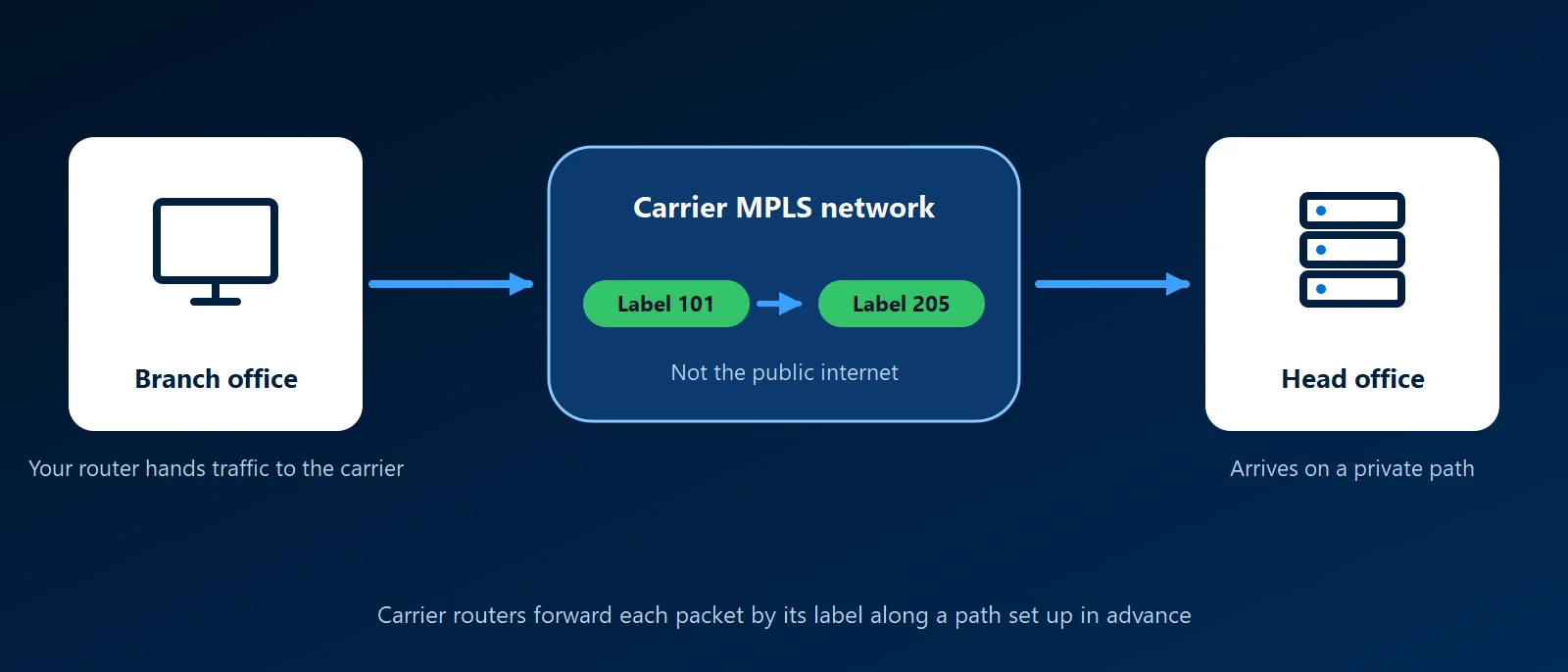
What it is
On an ordinary network every router looks at a packet's destination address and decides where to send it next. On an MPLS network the first carrier router attaches a short label to the packet, and every router after that forwards it by the label alone, along a path that was set up in advance. The last router removes the label and hands the packet to your site.
You do not run MPLS yourself. You buy it from a carrier as a service, often called MPLS VPN or IP VPN. The carrier installs a circuit at each location, and your sites see each other as if they were on one private network.
Why businesses use it
- Predictable performance: the carrier controls the whole path, so delay and packet loss stay steady. That matters for voice, video and old applications that do not tolerate a poor line.
- Traffic classes: the carrier can give phone calls priority over file transfers from end to end, which the public internet cannot promise.
- A service agreement: uptime and repair times are written into the contract.
- Separation: your traffic is kept apart from other customers and from the internet.
What to know before relying on it
- Private is not encrypted: MPLS separates your traffic from other customers, but it does not encrypt it. If the data is sensitive, encrypt it yourself.
- Cost: an MPLS circuit costs far more per megabit than business internet, and speeds are often lower.
- Slow to change: adding a site or raising a speed means a carrier order and can take weeks.
- Built for the head office: MPLS suits traffic between your own sites. Most work now goes to cloud services, and sending that through head office first only adds delay.
- One carrier: every site needs a circuit from the same provider or one of its partners, which limits choice in some places.
MPLS, VPN and SD-WAN
- Site-to-site VPN: an encrypted tunnel between offices over ordinary internet lines. Much cheaper and quick to set up, but performance depends on the internet between the sites. See our guide to VPNs.
- SD-WAN: equipment at each site that uses two or more lines at once, such as fiber and cable, measures them and steers each application over the best one. Many companies replace MPLS with it, or keep one MPLS circuit beside an internet line.
- MPLS: still a reasonable choice where steady voice quality or a contractual guarantee matters more than cost.
How KawaConnect works with MPLS
MPLS circuits are sold by carriers, and we do not resell them. Our work is on your side of the circuit: the firewalls and routers at each site, the routing between them, and what happens when a line fails. When a carrier contract comes up for renewal, we can help you compare the circuit with business internet and an encrypted tunnel built on OPNsense or WireGuard, and plan the change if it makes sense.
Related services
Networking and firewalls
Routers, firewalls and links between sites.
Network security
Encrypted connections between offices and for remote staff.
VoIP phone systems
Phone systems that depend on a steady network.
Learn more
- Multiprotocol Label Switching on WikipediaHow labels, label switching routers and paths work, with the history.
- Cloudflare: What is MPLS?A short explanation with the trade-offs against internet-based networks.
- RFC 3031: MPLS architectureThe original standard, for readers who want the detail.
Paying for circuits you are not sure you need
Tell us how your sites are connected today. We will tell you what each link is doing and what the alternatives would look like.
Start a conversation