
What is S-Video?
S-Video sends brightness (luma) and color (chroma) on separate wires through a 4-pin mini-DIN connector. The picture is sharper than composite video but below RGB and component.
Talk to an engineer Knowledge base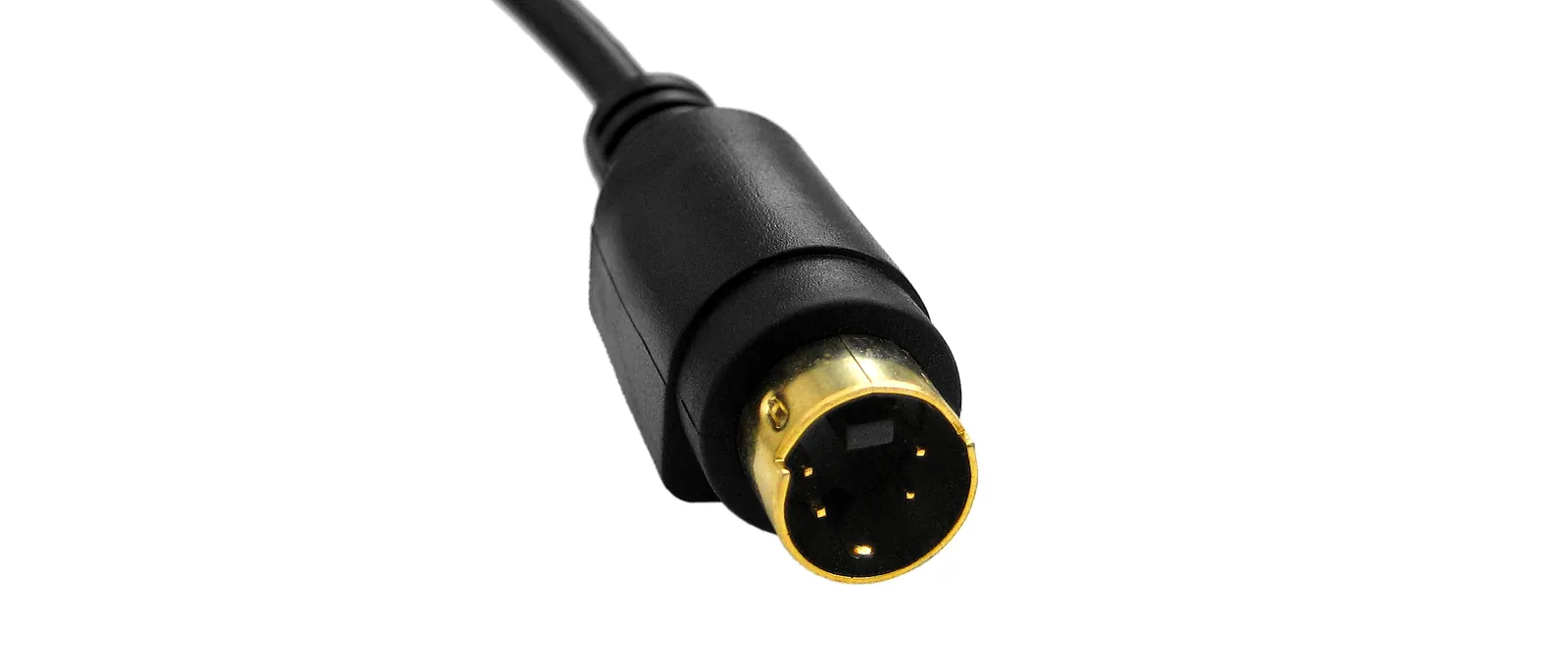
What it is
Composite video mixes luma and chroma into one signal, and the television has to pull them apart again. That causes dot crawl and color smearing around sharp edges. S-Video keeps the two apart, so the set has less to separate. The plug has four pins: a luma signal, a chroma signal and two grounds.
S-Video carries video only, so audio needs its own cables. It was common on 1990s consoles, camcorders, VCRs and CRT televisions. Its quality sits between composite and the RGB and sync signals, and some SCART sockets can carry it.
Why it matters
- Better than composite: if the console and the set both have S-Video, use it in place of composite for a cleaner picture.
- Both ends: the source must output S-Video and the TV must accept it. Many consoles never did.
- Audio: connect the red and white audio cables separately.
- Fragile pins: the thin pins of the mini-DIN plug bend. Line it up and push it straight in.
How this shows up in our work
Working CRT televisions and monitors are something we take in and rehome, and rare professional models we pay for. The CRT recycling page has the details.
Each set is tried with a real video source before it leaves us, and that includes the S-Video input if it has one.
Related services
CRT recycling
We collect working CRT televisions and monitors and rehome them.
Services
Everything else KawaConnect supports, from managed IT to phone systems and cameras.
Learn more
- S-Video on WikipediaCovers the connector, pin layout and signal in detail.
- Component video on WikipediaExplains the next step up in analog quality, which splits color into two more signals.
Have old video gear to rehome?
Tell us the brand, model and condition. We reply within one business day.
Start a conversation